

Salesforce Sales Cloud captures 46% of mid-sized business usage, yet only 21% among small businesses, according to recent CRM adoption data. That split tells you something: mid-market teams (100 to 500 employees) aren't shopping in the same aisle as startups or Fortune 500 companies, and they need CRM capabilities that scale with operational complexity, but most content about CRM selection pretends this segment doesn't exist.
The problem cuts both ways. Entry-level SaaS tools cap out on custom object modeling, multi-region data residency, and ERP integration depth right when a growing company needs those features most. Enterprise platforms like Salesforce deliver the functionality, but per-seat costs balloon fast once you're onboarding 150 or 200 users. HubSpot's Sales Hub, popular with smaller teams at 62% adoption, drops to 34% in the mid-market for similar reasons: pricing tiers and contact limits start working against you at scale.
The cost question is only half the story. Three shifts in 2026 make customization more urgent for mid-sized organizations than ever before:
- AI-native workflows are no longer optional. Teams using AI features in their CRM report revenue gains 1.3 times higher than those who don't, and 81% of sales teams now rely on AI for lead scoring, follow-ups, or forecasting. A CRM that can't embed AI into your specific sales pipeline is already behind.
- ERP integration complexity is growing. Mid-market companies typically run two to four operational systems (inventory, finance, HR, project management) that need to talk to the CRM in real time, and off-the-shelf connectors rarely handle custom data flows without expensive middleware.
- Compliance demands keep tightening. Regulated industries like healthcare, finance, and logistics face data residency and audit trail requirements that generic CRM platforms weren't architected to satisfy.
This article evaluates six CRM paths built for that reality, from highly configurable platforms to fully bespoke systems, each assessed through the lens of what mid-sized companies actually need in 2026.
What Should Mid-Sized Companies Prioritize When Choosing a CRM?
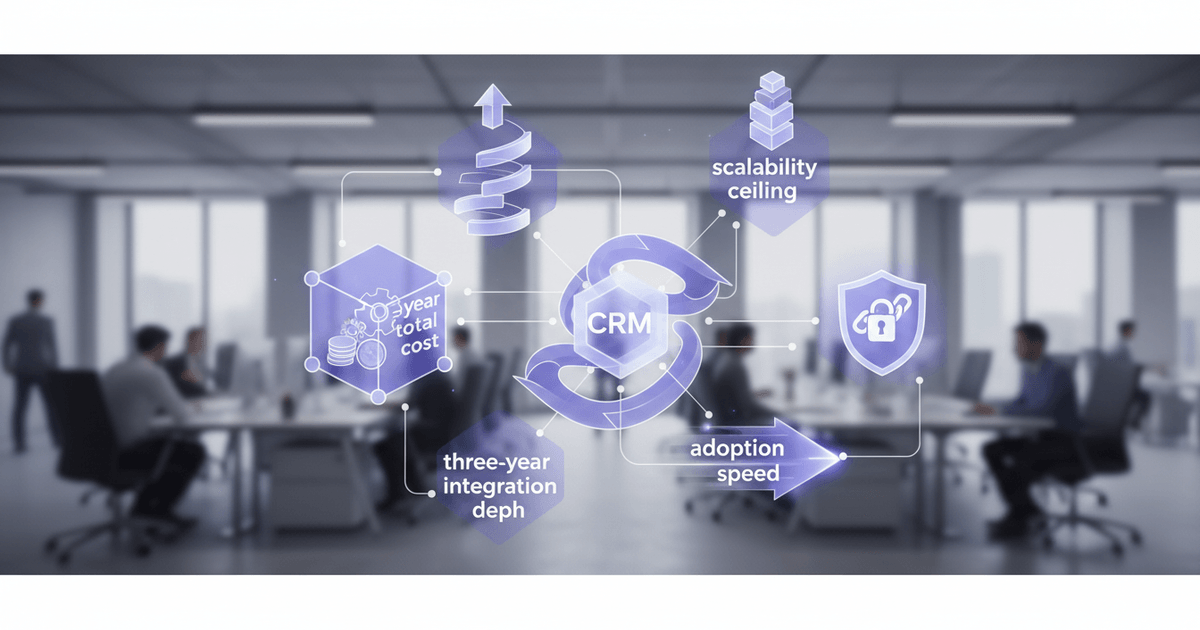
Mid-sized companies should evaluate CRM options against five criteria: three-year total cost of ownership, ERP integration depth, adoption speed, scalability ceiling, and data compliance.
Most CRM buying guides tell you to "pick the tool that fits your budget." That's incomplete advice, and it's why so many mid-market teams end up ripping out their CRM 18 months after deployment. The real question isn't what a platform costs per seat today. It's what the full system costs over three years once you factor in implementation, customization fees, API middleware, training, and the internal hours your team burns on maintenance.
As per Mordor Intelligence's SaaS CRM market analysis, SMEs (including mid-sized firms) represent the fastest-growing SaaS CRM segment, clocking a 24.9% CAGR — largely because low entry-tier pricing makes it easy to say yes. But here's the catch: high switching costs and tangled integrations trap companies once they've committed. That reality makes your initial platform decision far more consequential than it'll ever look on a quarterly budget spreadsheet.
Here's where the numbers get concrete:
| CRM Solution | Price per User/Month | 3-Year TCO (200 Users) | Best For | Customization Depth |
|---|---|---|---|---|
| Salesforce Enterprise | ~$165 | ~$1.19M | Complex sales orgs needing deep reporting | High (Apex code, custom objects) |
| HubSpot Enterprise Suite | ~$4,300/mo base + per-seat | ~$200K-$400K | Inbound-heavy teams with content workflows | Moderate (operations hub, custom properties) |
| Zoho CRM Enterprise | ~$40 | ~$288K | Cost-conscious teams wanting flexibility | Moderate-High (Deluge scripting, Canvas) |
| Pipedrive Enterprise | ~$99 | ~$713K | Pipeline-focused sales teams | Low-Moderate (limited backend access) |
| SugarCRM | ~$85 | ~$612K | On-premise or hybrid deployment needs | High (open-source heritage, full code access) |
| Fully Custom CRM | $150K-$300K build + $30K-$60K/yr maintenance | ~$240K-$480K | Orgs with unique workflows no SaaS covers | Complete (you own the codebase) |
Mid-Market CRM Cost Comparison: 3-Year Total Cost of Ownership at 200 Users
That table shows something you might not expect. A fully custom CRM can actually cost less over three years than Salesforce Enterprise or Pipedrive at 200 seats. Most people will tell you to start with a SaaS platform and customize it down the road — but for mid-sized companies dealing with complex, industry-specific workflows, building custom from day one often delivers stronger ROI. You're not stuck paying for workaround plugins, middleware layers, and per-seat price hikes that keep compounding year after year.
Integration complexity deserves its own hard look. A 200-person company usually runs an ERP, a marketing automation platform, at least one accounting tool, and a handful of vertical-specific apps. About 36% of companies cite integration as a top CRM priority — and that number makes sense. For mid-market teams, a broken API connection between your CRM and ERP doesn't just create data silos; it brings operations to a grinding halt. So before you evaluate any platform, map out every system your CRM needs to talk to. Then verify whether those integrations are native, require middleware, or demand custom software development to actually work reliably.
Team buy-in is the hidden threat to CRM projects. A $1M platform your sales reps refuse to touch? That's negative ROI, plain and simple. Mid-market companies seldom have dedicated CRM administrators on staff, so the system has to be intuitive enough that a regional sales manager can pull together a report without filing an IT ticket. Roughly 45% of businesses rank automation as their top CRM requirement — meaning the platform should handle lead routing, follow-up sequences, and pipeline stage transitions without anyone lifting a finger.
Scalability ceiling and data ownership round out the evaluation. Say you're at 200 employees with 20% annual growth — your CRM has to support 300-plus users within two years without hitting a pricing tier jump that doubles what you're spending. Data ownership is just as critical. Mid-market companies are increasingly operating across multiple jurisdictions, and regulations like GDPR, SOC 2, or industry-specific compliance rules dictate where customer data lives and who actually controls it.
If your team can't clearly answer "where does our customer data physically reside, and who holds the export rights?" before finalizing a CRM contract, don't sign it.
The decision framework is simpler than most vendors want you to believe. If your workflows map cleanly to a configurable SaaS platform's feature set and your three-year TCO stays under your budget ceiling, go SaaS. If you're spending more than 30% of implementation time building workarounds, custom objects, and middleware to force-fit a platform to your process, that's the signal to evaluate a bespoke CRM build instead.
1. Salesforce (Enterprise Edition): How Does It Serve Mid-Market Teams?
Salesforce Enterprise Edition runs $165/user/month — which means a 200-seat mid-market deployment hits roughly $396,000 per year, and that's before you factor in add-ons or implementation fees.
That figure hits hard. It doesn't account for AppExchange subscriptions, Salesforce-certified admin salaries, or the consulting hours you'll burn through during a 4-to-6-month implementation cycle. Think about a 200-person distribution company or a regional healthcare network. The three-year total cost of ownership can quietly creep past $1.5 million once you start layering in CPQ modules, custom API work, and Einstein AI licensing.
The platform's strengths are genuine. Salesforce's ecosystem still stands apart when it comes to integration depth — thousands of AppExchange connectors cover everything from ERP sync to marketing automation. Einstein AI capabilities line up with a wider industry trend: 81% of sales teams now use AI tools, and those teams report roughly 1.3x revenue improvement. If your sales pipeline already runs through Salesforce, adding predictive lead scoring and automated follow-ups isn't a heavy lift.
The mid-market friction shows up in two places:
- Configuration complexity. Most teams between 100 and 500 employees don't have a dedicated Salesforce admin on staff. Without one, you're either shelling out $150-250/hour for a consultant or watching your instance slide into disarray within six months. Enterprise teams depend on features like Flow Builder automations, custom objects, and permission sets — all of which demand continual maintenance that smaller IT teams simply can't absorb.
- Feature bloat. Salesforce ships capabilities built for 10,000-person organizations. A mid-sized logistics firm with 30 sales reps doesn't need territory management hierarchies five levels deep. That excess generates noise in the UI, slows user adoption, and buries the CRM features that actually drive small and mid-sized business growth under layers of functionality nobody touches.
The average Salesforce user adoption rate sits at 72%, meaning nearly three out of ten licensed seats go underused. For a mid-market team paying $396K a year, that's over $100K in wasted licenses annually.
Salesforce Enterprise makes sense for mid-sized companies already embedded in the ecosystem, those running Marketing Cloud, Tableau, or MuleSoft integrations where ripping out the CRM would mean rebuilding half their tech stack. It also fits teams that genuinely need deep third-party integration across 50 or more tools. For everyone else, the gap between what you pay for and what your team actually uses is where custom CRM development starts to look like the more efficient path.
2. HubSpot (Enterprise Hub): When Does It Outgrow Mid-Sized Needs?
HubSpot's Enterprise CRM Suite starts at $4,300/month — and mid-sized companies with growing contact databases tend to hit pricing and customization ceilings much quicker than the onboarding brochure would have you believe.
The onboarding cost hits $3,500 or more, and that's before you factor in implementation scope. If you're running a 150-person logistics firm or a multi-location staffing agency, that $4,300 monthly baseline doesn't stay put for long — it climbs fast once your contact database blows past the included tiers. Each pricing jump feels out of proportion to what you actually unlock. It's especially frustrating when custom object limits start boxing in how you model complex B2B relationships.
The platform's strengths are real — no caveats needed there. Marketing-sales alignment inside HubSpot is arguably the strongest you'll find in the mid-market SaaS tier. Its UI stays intuitive enough that teams actually use it. CRM adoption data backs this up: a 71% user adoption rate, which is unusually high for any enterprise-grade tool. Inbound lead management workflows, email sequences, and attribution reporting all work together without requiring third-party middleware. Right now, about 45% of companies are prioritizing automation in their CRM stack, and HubSpot's built-in workflow builder handles that well — especially for inbound-heavy models.
The actual friction isn't on the marketing side — it's reporting depth. Mid-sized teams running multi-touch B2B sales cycles need granular pipeline analytics, custom dashboards that pull directly from ERP data, and cross-object reporting that goes well beyond HubSpot's standard toolset. Operations Hub can patch some of those gaps, but that's yet another line item on the invoice. The broader CRM trends shaping 2026 all point toward deeper integration demands — and HubSpot's closed ecosystem has a hard time keeping up without heavy API workarounds.
HubSpot Enterprise makes strong sense for marketing-driven mid-sized companies where inbound content and lead nurturing generate the bulk of revenue. Picture a 200-person SaaS company pulling 80% of its pipeline through content and webinars—that team will get real value from the native marketing-to-sales handoff. Now consider a manufacturing distributor managing 15,000 SKUs across three warehouses. That business needs custom object flexibility and ERP sync depth this platform simply wasn't built to deliver. If your growth model is inbound-first and your data model stays relatively flat, HubSpot won't disappoint. But the moment operational complexity outpaces its object structure, you're stuck paying enterprise prices for what are essentially mid-market capabilities.
3. Zoho CRM (Enterprise): Why Is It the Budget-Friendly Mid-Market Pick?
Zoho CRM Enterprise runs about $40/user/month — and for that, you're getting configurable workflows and AI-powered lead scoring at roughly one-quarter the per-seat cost of enterprise-tier competitors.

A 200-seat deployment runs about $96,000 a year. Compare that to Salesforce at $396,000, and the math is hard to argue with. For a 250-person manufacturing distributor or a regional insurance brokerage operating on razor-thin margins, that $300K difference doesn't just cover the full implementation budget — it leaves enough left over for add-ons too.
The Canvas design studio is where Zoho earns its customization reputation. Teams can rebuild CRM views, module layouts, and data entry forms without writing code, which means your operations manager can restructure the sales pipeline interface on a Tuesday afternoon without filing a dev ticket. Zia, Zoho's AI assistant, handles lead scoring and anomaly detection across your pipeline. According to Webbycrown's CRM market share analysis, SME-focused CRM tiers like Zoho's are growing at a 24.9% CAGR, reflecting how aggressively mid-market buyers are moving toward cost-efficient platforms.
The broader Zoho ecosystem (Books for accounting, Desk for support, Projects for task management) offers tight native integrations that cut out the need for middleware. If you're running a lean IT team and juggling five or six business tools at once, that matters — no extra connectors, no duct-taping systems together just to keep things talking to each other.
The compromises are genuine. UI refinement won't compare to what you'd get from more consumer-oriented platforms, and things can get chaotic quickly once you've activated several modules. Connecting third-party apps outside the Zoho ecosystem takes noticeably more configuration effort than platforms with larger marketplace networks. If your tech stack relies heavily on non-Zoho tools — Slack, Jira, or specialized ERP systems — expect to set aside extra hours for API setup and testing.
Zoho CRM Enterprise makes the most sense when your mid-sized company needs deep configurability, AI features, and ERP-adjacent integrations — but doesn't want to cross into six-figure annual licensing territory. At this tier, the functionality you get per dollar is genuinely hard to beat.
4. Pipedrive (Enterprise): How Well Does It Scale Beyond Sales Teams?
Pipedrive Enterprise at $99/user/month stands out for visual sales pipeline management and quick onboarding, but its weak cross-department capabilities make it hard to scale for mid-sized companies.
Pipedrive earned its name by doing one thing really well: making sales pipelines ridiculously easy to manage. The drag-and-drop interface gets reps up and running in days rather than weeks, and its sales-focused AI features help teams prioritize deals and forecast revenue with impressive precision. For a 175-person commercial real estate brokerage where deal velocity directly shapes quarterly performance, that pipeline-centric design feels like it was custom-built for the job.
Pipeline management alone doesn't tell the full story for mid-market operations, though. Think about a growing facilities management company with 300 employees — they need customer service ticketing, project tracking for active contracts, and finance integration for recurring billing. Pipedrive simply doesn't handle those workflows out of the box. You'll end up cobbling together third-party tools for support, project management, and cross-department reporting. That fragments your data and creates the very silos a CRM is supposed to eliminate.
Most people assume Pipedrive's marketplace integrations cover these gaps well enough. But in practice, bolting on separate tools for service, project management, and ERP sync creates real maintenance headaches — and the data latency that comes with it chips away at the speed advantage you got from Pipedrive's clean sales interface. Teams that need AI-powered CRM capabilities spanning sales, service, and operations often discover that a purpose-built system simply outperforms an assembled stack of point solutions.
Pipedrive Enterprise works well for a specific type of business: sales-focused mid-sized companies where pipeline velocity is the main KPI and other departments run on their own. But here's the thing — if your growth path demands tighter integration between sales, support, and fulfillment, you'll outgrow this platform faster than that $99/user price tag would suggest.
5. SugarCRM (Enterprise): What Makes It a Mid-Market Contender?
SugarCRM's open-source heritage and time-aware data tracking make it a strong fit for regulated mid-sized companies needing full audit trails and on-premise deployment options.
Most CRM platforms store your current customer record. SugarCRM stores every version of it. The time-aware feature tracks historical changes to contacts, accounts, and opportunities, creating a complete audit trail that compliance officers in financial services and healthcare actually rely on. For a 400-person credit union managing regulatory examinations across multiple state jurisdictions, that historical data layer isn't a nice-to-have. It's the difference between passing an audit in two days versus two weeks.
The modular Serve/Sell/Market suite lets you buy only what your team needs. A mid-sized wealth management firm might start with Sell for pipeline tracking, add Market six months later when the client acquisition strategy matures, then layer in Serve once support volume justifies it. On-premise deployment remains available for organizations where cloud storage of client financial data creates compliance friction.
| Factor | SugarCRM Enterprise | Typical Mid-Market SaaS CRM |
|---|---|---|
| Deployment options | Cloud or on-premise | Cloud only |
| Historical data tracking | Time-aware (full audit trail) | Current record snapshot |
| Customization depth | Source-code level (open-source roots) | UI-level configuration |
| Ecosystem size | Smaller partner/integration network | Large app marketplaces (500+ integrations) |
| Average onboarding timeline | 8-14 weeks with developer resources | 2-6 weeks self-service |
The open-source roots mean your development team can modify SugarCRM at the source-code level, not just drag and drop modules in a visual builder. That's a genuine advantage when you need custom data models for complex regulatory reporting. The trade-off: the learning curve is noticeably steeper than what teams experience with Pipedrive's drag-and-drop simplicity, and the integration ecosystem is smaller than what you'd find with major SaaS platforms.
SugarCRM fits best when compliance requirements drive your CRM decision. If your mid-sized company operates in finance, healthcare, or any sector where regulators audit customer interaction histories, the time-aware tracking and on-premise option solve problems that most off-the-shelf platforms simply weren't built to address. The CRM market's growing diversification into vertical sectors (retail alone is projected to capture 21% of CRM market share by 2034) signals that specialized, customizable tools like this will only become more relevant.
6. Fully Custom CRM: When Should Mid-Sized Companies Build Their Own?
Mid-sized companies should build a custom CRM when per-seat licensing costs climb past $80K a year, unique workflows slam into platform ceilings, or data sovereignty rules flat-out eliminate shared infrastructure as an option.
None of the five platforms above can reshape their core architecture around your business. They bend, sure. But picture a 350-person logistics broker running proprietary route-optimization algorithms alongside customer engagement tracking — at some point, you'll hit a wall where configuration options dry up and workarounds start breaking.
The cost argument is often more compelling than the flexibility one. A custom CRM build typically runs $150K to $300K upfront with $30K to $60K in annual maintenance. For a company with 200 users, that's breakeven territory within 12 to 18 months compared to enterprise SaaS licensing that compounds year after year. After that crossover point, every dollar saved drops straight to the bottom line.
Custom development tends to make sense in four specific scenarios: compliance mandates that demand full data ownership (think ITAR-regulated aerospace suppliers), competitive differentiation built around proprietary sales processes, ERP and API integration depth that off-the-shelf connectors simply can't handle, and AI features trained on your actual operational data—not generic models. According to CRM industry research, roughly 8% of organizations already prioritize deep customization. That number keeps climbing as companies stack on AI and ERP requirements.
One thing people rarely talk about with custom builds: the real ROI isn't just about licensing savings. It's in killing off the shadow tools — spreadsheets, Slack workarounds, manual exports — that pile up when a platform can't keep pace with how your team actually works. An in-depth guide on building flexible custom CRM solutions walks through the development process and timeline considerations for mid-market teams weighing this route.
Custom CRM development makes the strongest financial case when you've got 150 or more users, complex compliance requirements, or proprietary workflows that no off-the-shelf platform can handle without heavy modification. Below that threshold, configurable platforms like those covered in earlier sections tend to deliver faster time-to-value.
Frequently Asked Questions About Mid-Market CRM Selection
How much does a custom CRM cost for a mid-sized company?
Expect to invest $150K to $300K upfront for development, plus $30K to $60K each year in maintenance. That looks steep initially. But compare it to enterprise SaaS licensing for 200 users — you're easily looking at $400K per year — and the numbers shift in a hurry. Most custom builds hit breakeven within 12 to 18 months because they wipe out per-seat pricing altogether.
When should a mid-sized company switch from off-the-shelf to custom CRM?
Look out for these signs: your team's burning more than 20 hours a month on workarounds, total per-seat costs have crept past $80K annually, or you need industry-specific workflows no platform offers natively. Data sovereignty demands that SaaS providers just can't fulfill? That's another dead giveaway.
What CRM features matter most for companies with 100 to 500 employees?
Role-based access controls and cross-department workflow automation sit at the top of the priority list. But that's not everything—you'll also need ERP and marketing automation integration, management reporting dashboards, and flexible architecture that won't hit you with per-seat fees as your team scales. Data migration tools matter way more than most buyers realize. Switching costs pile up fast once you're locked into a platform, and by that point, it's too late to negotiate a cheap way out.
How long does it take to implement a CRM for a mid-sized company?
Ready-made platforms typically need 2 to 4 months for setup and onboarding. Custom CRM projects? Expect 3 to 6 months just to deliver an MVP, with iterative feature rollouts following after that. Either timeline can stretch quite a bit if you're dealing with tricky data migration or trying to hook into legacy ERP systems.
Can a mid-sized company migrate from an existing SaaS CRM to a custom build?
Yes. Phased migration is the standard approach — you export core data, map custom fields to the new schema, rebuild automations, and run both systems side by side during the transition. Core data migration generally takes 4 to 8 weeks. Full workflow migration wraps up in 2 to 3 months, though it can stretch a bit depending on how complex your automations are.
Ready to Explore a CRM Built for Your Mid-Sized Company?
If your team has outgrown generic SaaS tools and workarounds are eating into productivity, a bespoke CRM system designed around your actual workflows can change the trajectory. See how custom CRM systems built for mid-sized companies can match how you actually sell, not how a platform assumes you should.